

One Wink Plot
Lady Jane cashes in a favour and drags Lovejoy to drinks with Sir Hugo and Lady Felicity Carey-Holden, to price up whatever their great-great-grandfather shipped home from the Grand Tour. Almost all of it is junk. The exception, buried in the catalogue as School of Florence, is a Nicolo Gorini bronze worth two million — and Lovejoy works out where it went long before its owners do. Since Hugo has also cheerfully disinherited his younger brother Douglas, who paints and casts bronze rather too well, that knowledge soon finds a use.
Review
"And I discovered that Lovejoy is a banger."
— Count Binface, candidate for Clacton
It is still August and it is still a drought. The grass has gone the colour of a manila envelope and the water company has started using the word "resilience" in its letters, which is what companies write when they mean "no".
It is also the week of the Clacton by-election, a contest Nigel Farage arranged for himself by resigning the seat he won two years ago, on the grounds that the voters of Clacton — rather than, say, the Parliamentary Standards Commissioner — should be the ones to judge the £5 million a crypto investor handed him in April 2024. He has explained that the money was for his personal security. He has also explained that it was a reward for twenty-seven years of campaigning for Brexit. He appears genuinely baffled that anyone might look at either explanation, or at both of them standing next to each other, and wonder whether a gift that size ever really arrives without strings.
Labour, the Conservatives, the Liberal Democrats, the Greens and Restore Britain have all declined to turn up at all. That leaves a record thirty-four candidates on the ballot and exactly one real challenger: an intergalactic warrior in a wheelie bin, whose manifesto commits him to justice, lasers, affordable croissants and the return of Ceefax. Asked what he had found on this planet worth the trouble of defending, he gave the answer at the top of this page.
So this week, for once, the bridge built itself.
Binface will not win. But he has already made his opponent look like a bad Mussolini reproduction: heavy on the jaw, light on the provenance. Which, as it happens, is more or less this week's subject.
And talking of punchable faces, The Italian Venus has a magnificent one. Sir Hugo Carey-Holden is Patrick Malahide, who by 1991 had spent the best part of a decade as DS Charlie Chisholm in Minder, being outmanoeuvred week after week by a second-hand car dealer and his minder.
He is not even half the cast. Celia Imrie plays his wife, decades before the nation came to know her for something rather less refined — of which more below. Nicholas Farrell, who played Aubrey Montague in Chariots of Fire, is his disinherited brother. Ian McNeice is the expert. Quite a crew for a Sunday night in the early nineties.
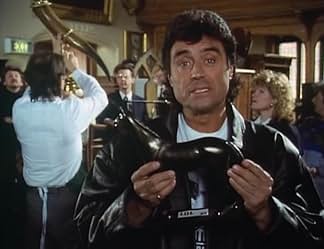
And the episode is a gem. It opens in a saleroom (as the best Lovejoy episodes do), in that peculiar auction dialect of winks, half-nods and eyebrow-bids where a man can spend eight hundred pounds without appearing to move a muscle, and where Lovejoy watches a bronze horse after Landseer go under the hammer while quietly noting three things: that it is a fake, that it is the third one he has seen, and — the line that sets the whole hour running — that it is possibly better than the original.
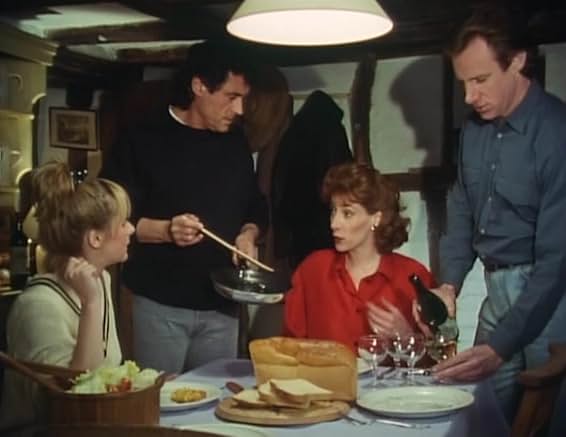
From there he is dragged into helping Lady Jane, which this week means an afternoon with more of her awful friends. That is two weeks running if we count Michael from Just Desserts, and I am starting to think Jane's address book — the Felshams' more generally — is the most dangerous object in Suffolk.
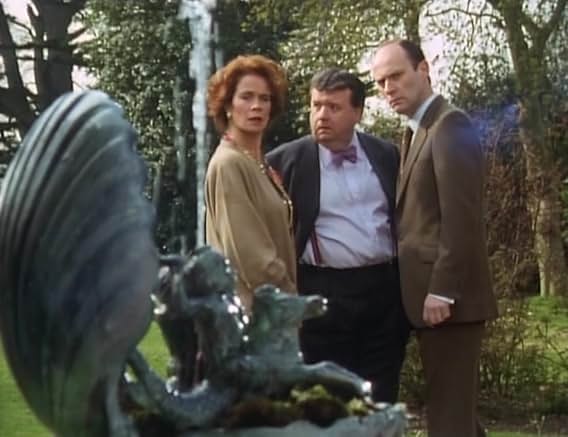
Pleasingly, the treasure is another plain thing. Not a jewel, not a canvas, but what looks for all the world like an outsized soap dish: half a Renaissance bronze group, a scallop shell with seahorses on it, which once carried a nude Venus in the manner of Botticelli's The Birth of Venus. It has spent the last few decades in a goldfish pond, being rained on.
Lovejoy helps out. Then the helping-out twists, as it always does, and for his trouble he is clouted round the head by the very man he is trying to help.
Structurally this is the first proper Lovejoy builds a sting of the nineties run, and it is all the better for being simple: no murder, no chase, just a greedy man being sold exactly what he asked for.
Lovejoy goes to hospital — well, is abandoned there — and gets some stitches from a student. Eric: "I've seen better needlework on a Sunday joint." He will be back at this hospital in the farcical Eric of Arabia in Series Three.
Which is where the episode properly gets going, because a clout round the head has never once stopped Lovejoy having an idea.
The idea needs Gervais Rackham, and the scene where Lovejoy recruits him is the best two minutes in the hour. Rackham asks, reasonably, whether he is being blackmailed. "Nearly," says Lovejoy. Ian McNeice plays the whole thing like a man being force-fed an enormous cake entirely against his will, and I could watch him do it all afternoon. All Rackham has to do, he is assured, is identify a genuine Gorini as a genuine Gorini — which is perfectly true, and also the most dishonest sentence in the episode.
Then the squeeze. Lovejoy floats the Venus at ninety-five grand and lets it climb to two hundred and twelve for cash — and never once tells Hugo he already owns the other half. He lets Rackham do that by accident, on a stroll round the garden, where the missing shell has been gurgling away in the goldfish pond for decades. Hugo is never actually sold anything. He is simply allowed to work out, all by himself, that he is about to be very clever.
Which is when the Carey-Holdens damn themselves. Rackham was promised one per cent for finding the shell — thirty or forty thousand — so having found it, Hugo decides a verbal agreement isn't an agreement and noticing something in a garden isn't finding it. Rackham settles for a thousand. Felicity leans in to ask whether that includes VAT. Anyone who has ever sent an invoice will feel a vein go. She then trims Lovejoy's fee too, and tells him kindly that she doesn't blame him for trying it on. These people are being relieved of a fifth of a million pounds and they still cannot stop haggling over the tip.
But the thing that makes the episode is the lamp. Lovejoy dreams about the bronze and wakes up knowing. The real Venus — the two-million-pound one, the half everybody has spent the hour hunting — has been standing in the drawing room all along with a shade on its head. Grandpa sawed the group in two: the shell went in the pond, the goddess got wired for electricity.
So Jane takes Felicity out to lunch, and Lovejoy sells a rich man a forgery in a room containing the original.
The wash-up is genuinely warm, which not every Lovejoy sting manages. Douglas gets his inheritance in cash — not all of it, but a good deal more than Hugo ever intended him to see. Rackham has been showing the bronze horse round the trade to universal praise, so Douglas ends the hour as a coming man with two agents circling him and ten per cent going to whichever he likes best. Eric requires lager, dry-roasted crisps and pork scratchings. And Jane's mysterious favour, hanging over the whole episode, turns out to be two months' free rent.
Then Hugo rings. He now owns two bronzes, one of which he paid a fortune for, and he has a suggestion about where the next one is going. We never hear the end of the sentence, which is the correct decision.
Favourite Moment
Normally this is where I pick a scene. Not this week.
My favourite moment is the discovery that somewhere on Thursday's ballot paper there is a candidate for the United Kingdom Parliament whose manifesto commits him, in writing, to Lovejoy. Not "the arts". Not "our television heritage". Lovejoy — sandwiched between affordable croissants and the return of Ceefax.
Thirty-five years after this episode went out on a Sunday night, a man in a wheelie bin has done more for Lovejoy's standing than anyone has managed since the show ended in 1994. I have no idea what he would make of the Gorini, but I am fairly confident he would have spotted the lamp.
Good Quote
Gervais Rackham, ringing in with a progress report he is enjoying far more than he will admit:
"Your foul little plan appears to be working."
Guest Focus — Celia Imrie
Celia Imrie is Lady Felicity Carey-Holden — four years before Acorn Antiques made her a household fixture, and a full thirty-four before she achieved a rather different sort of immortality by breaking wind on national television in The Celebrity Traitors. There is no career plan that gets you from one of those to the other. She should be extremely proud of both.
What she does here is cleverer than simply playing snobbish. Felicity is the one angling for free valuations, the one who says "yah", and the one who personally short-changes both the expert and the con man on her husband's instructions while remaining perfectly, blithely charming about it. She is also the last person on screen, admiring a forgery in her own drawing room and finding it strangely familiar.
The Divvy Verdict
Anyway — I like this episode. We don't have any Tinker so it can't be a full five, but this is an episode that ticks all of my Lovejoy boxes and, whilst I was born on planet earth, if I wasn't I would have been happy to spaceship over to watch it.