

One Wink Plot
One antique dresser, one secret drawer and one recently released psychopath. What could possibly go wrong? Also, somehow, we're back on a boat for a budget East Anglian remake of Captain Phillips.
Review
"You'd better run, you'd better hide..."
"Here come the twentieth century's latest scam..."
This episode starts brilliantly. Nick Lowe's Half a Boy and Half a Man drifts through the opening sequence while Lovejoy tunelessly sings along, and for twenty minutes or so The Axeman Cometh feels like the show settling into the formula that would carry it through the next six series.
Unfortunately, once the action moves to London it loses a little momentum and wanders into the kind of ethnic stereotyping that hasn't been fashionable since Alf Garnett was considered cutting-edge entertainment.
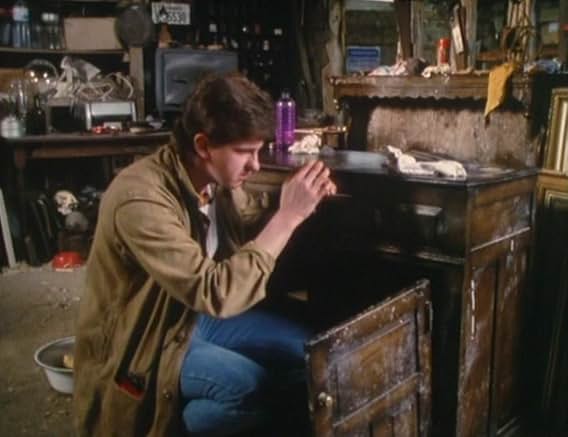
After spotting a magnificent Welsh oak dresser at auction, Lovejoy employs one of his trademark manoeuvres to keep it out of rival Charlie Gimbert's hands. The resulting auction scene gives us the immortal cry heard in the opening titles:
"At three fifty. Lovejoy!"
So now we know. It was the dresser all along.
The opening scenes are a delight. First, a frantic car chase through Suffolk lanes as Lovejoy attempts to evade what appears to be a criminal mastermind but turns out to be something far more terrifying: a tax collector. Then it's off through the market square, into Dandy Jack's antiques shop to hide out (which, in fairness, is pretty much Dandy's entire contribution to the episode), and finally into the café where the tax lady catches up with him. Lovejoy owes £10,000.
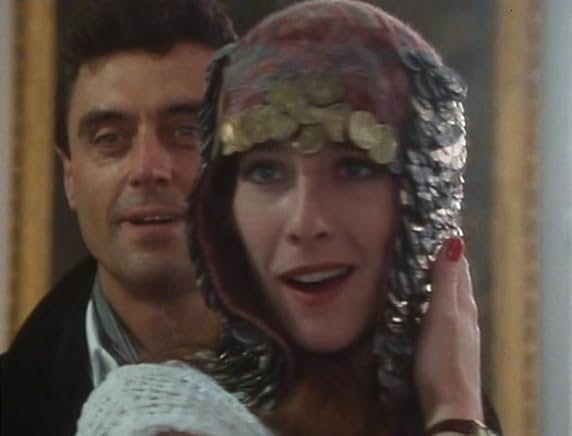
The dresser itself contains a hidden compartment concealing an Arabian bridal headdress decorated with Venetian gold ducats. Lovejoy immediately places it on Lady Jane's head and both admire it reverentially. To my eyes it resembles a cross between a medieval mail coif and something issued by the NHS for a particularly unfortunate course of chemotherapy.
Consulting Friedberg's Gold Coins of the World (which, remarkably, turns out to be a real book), Lovejoy calculates that the twelve Venetian ducats are worth around $27,000. Why the valuation is in dollars rather than pounds remains one of the episode's lesser mysteries.
Naturally, such treasures cannot possibly be sold in Lavenham, so off to London our hero trots. Unfortunately this is where the episode loses some of its charm. The Fantastic Four of Lovejoy, Lady Jane, Eric and Gimbert are largely left behind in favour of a collection of less memorable London characters.
Chief among them are Vial, a French dealer whom Lovejoy barely seemed to know at the auction but now treats like an old friend, and an eccentric Jewish coin expert whose characterisation feels rather more 1936 than 1986.
A footnote that only becomes available five years later. Also among those forgettable London faces is a dealer named Frobel, played here by Oliver Cotton — and Frobel, it turns out, is the one somebody thought worth keeping. He returns for the Series Two finale, The Black Virgin of Vladimir, promoted to Mordechai Frobel and recast with James Booth in the part. Same character, different actor, half a decade apart, and not a word anywhere to suggest we have met the man before. So much for less memorable.
Meanwhile, newly released psychopath Catesby is on the trail. Having spent years in prison dreaming of the treasure hidden inside his Welsh dresser, he is understandably annoyed to discover that while the dresser has been returned, the valuable contents have not. Armed with an axe, a grievance and what may be the most enthusiastic Welsh (hint of Cockney) accent committed to British television, he sets off in pursuit.
And because this is apparently a nautical series now, the climax eventually unfolds aboard a London narrowboat in a hostage situation that feels suspiciously like somebody accidentally remade Captain Phillips three decades early and on a considerably tighter budget.
"You'd better run, you'd better hide..."
Unfortunately, that's exactly what the episode does. As soon as Lovejoy and the plot run down to London, both start to lose their way. Much like Murder, She Wrote, the episodes away from Cabot Cove are rarely as good as the ones set there. Lovejoy belongs in Suffolk market squares, village auctions and slightly shabby antique shops. Remove him from that world and some of the magic disappears.